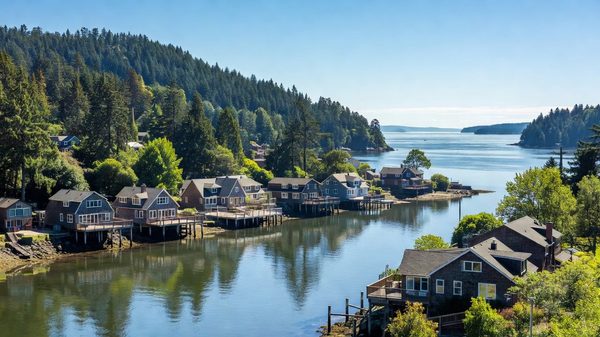
Anacortes City Council unanimously adopted the updated Anacortes Community Forest Lands Plan on May 4, 2026, following a public hearing in March and a staff presentation in April. The plan is now in effect and governs the city’s management of the ACFL until the next scheduled update, which is due by May 2031.
For buyers looking at homes on Fidalgo Island, the ACFL is one of the defining features of the Anacortes market and one of the least understood. The updated plan is a good occasion to be precise about what it is and what living beside it involves.
What the ACFL is
The Anacortes Community Forest Lands comprise more than 2,950 acres within the City of Anacortes — municipally owned forest land held by the city and managed for a combination of purposes. It is not a state or national park, and it is not a private preserve. It belongs to the city, which is the fact that governs everything else about it.
The city describes the forest as serving several functions at once: emergency drinking water protection, wildlife habitat, recreation, climate resilience, and education. The plan’s stated purpose is to establish a framework balancing conservation, public access, and sustainable management over the coming decades.
Nearly 3,000 acres of forest inside a city of Anacortes’s size is genuinely unusual. It is the reason the island has the trail network it does, and it is a substantial part of why Anacortes commands a premium in Skagit County’s market.
What the plan does
The plan is a management framework rather than a land-use regulation aimed at private property. It sets direction for how the city stewards its own forest — recreation and trail management, forest health and vegetation management, water resource protection, and the balance struck between public access and habitat.
The Anacortes City Council paired the plan’s adoption with related code changes, expanding the municipal code provisions that govern the forest lands.
One operational item from the adopted plan that has drawn local attention: it identifies the possibility of hiring a full-time ranger, at an estimated annual cost of around $250,000. That is a meaningful municipal expenditure, and it signals that the city expects to actively manage use levels rather than let the trail network run informally.
The five-year update cycle matters for buyers. This is a document that gets revisited on a predictable schedule with public comment periods. If you buy adjacent to the ACFL and care about how it is managed, the next comment window is a known quantity rather than something you have to catch by chance.
What living next to it is actually like
This is where buyer expectations most often need calibrating, in both directions.
The trail access is the real draw, and it is genuinely excellent. The ACFL carries a large network of trails used for hiking, trail running, and mountain biking, reaching lakes, forest, and viewpoints across Fidalgo Island. A home with a trailhead within walking distance has an amenity that does not depend on a car, a membership, or a drive off the island. For buyers relocating specifically for outdoor access, this is usually the thing that sells Anacortes over Bellingham or Whidbey.
Public land means public. The corollary is that adjacency brings people. Trailheads generate parking on nearby streets, foot traffic on the shoulders, and dogs. Homes closest to popular trailheads see this most, particularly on summer weekends. This is not a defect — it is what a well-used urban forest looks like — but a buyer who imagines a private woodland backdrop has misread the situation.
It is a working forest, not a preserve. The city manages the ACFL for forest health, which includes vegetation management and, at times, active forestry operations. Buyers should not assume the tree line behind a property is permanently fixed in its current state. Ask about planned management activity in the vicinity.
Wildfire and defensible space. Forest adjacency on Fidalgo Island carries wildfire considerations. Ask about defensible space requirements, check the property’s vegetation management, and confirm insurability with your carrier before removing contingencies. Some carriers price or restrict forest-adjacent coverage.
Wildlife. Deer are constant and will end any unfenced gardening ambition. Assorted other wildlife comes with the territory.
Due diligence for an ACFL-adjacent purchase
Establish the actual boundary. “Backs onto the forest” in a listing may mean a shared property line with city land, or it may mean a private parcel between the home and the ACFL that could later be developed. A survey and a parcel map settle this; a listing description does not.
Find the nearest trailhead and visit at peak. Walk the area on a Saturday morning in good weather, not on a Tuesday in the rain when the agent scheduled the showing. Parking pressure and foot traffic are visible only when the forest is being used.
Check access rights. Some properties have direct trail access from the parcel; others require walking to a public trailhead. Confirm whether any claimed private access is a recorded right or an informal arrangement with a neighbor.
Read the plan itself. The adopted plan is a public document available through the city, and the plan update page is the starting point. If a specific trail, access point, or management area affects the property you are considering, the document is the authority. The city’s assistant director is the listed contact for questions.
Ask about the water function. The forest’s role in emergency drinking water protection means some areas carry management priorities tied to water resources. Understanding whether a property sits near one of those areas is worth the question.
What it means for value
The ACFL is a structural support for Anacortes property values in a way that is easy to overlook. Nearly 3,000 acres of city-owned forest inside the municipal boundary is land that will not become subdivisions. On an island where developable land is already constrained by geography, that permanence compounds the scarcity that keeps Anacortes priced above the Skagit County median.
Buyers sometimes read the recent plan adoption as a change in that picture. It is better understood as a confirmation of it — the city recommitting, on a five-year cycle and with an expanded code framework, to managing the forest as forest. For anyone weighing an Anacortes purchase against a comparable home in Burlington or Mount Vernon, that permanence is a real part of what the premium buys.